Through the second half of the 20th century, the pulp and paper industry was often treated as an environmental villain. The release of stinky sulfur gases to air, the contamination of water bodies with chlorinated compounds, the disposable consumer culture, the extensive deforestation and the unacceptably high water consumption did not help at all. Much paper was used once and thrown away, while recycling systems were still uneven and many forests were not managed sustainably.
At the same time, plastics and other petrochemical-based materials were often marketed as modern, cheap, durable and convenient. Yet this shift created a new problem: those materials do not biodegrade, persist in landfills and oceans, contribute to climate change and work as vectors for environmental nightmares. Plus, they are more difficult to recycle than paper. You have heard of them, and probably not for a good reason: microplastics, garbage patches, PFAS… Choose your poison.
Today, paper is being considered by European lawmakers as an important alternative when it is responsibly produced, reused and recycled. The amounts of chlorine and sulfur compounds released by modern pulp mills are orders of magnitude below what they used to be, sustainable forestry is considered a must, recycling rates have increased and water consumption has drastically decreased. Not less importantly, carbon neutrality is a possibility for integrated paper mills!
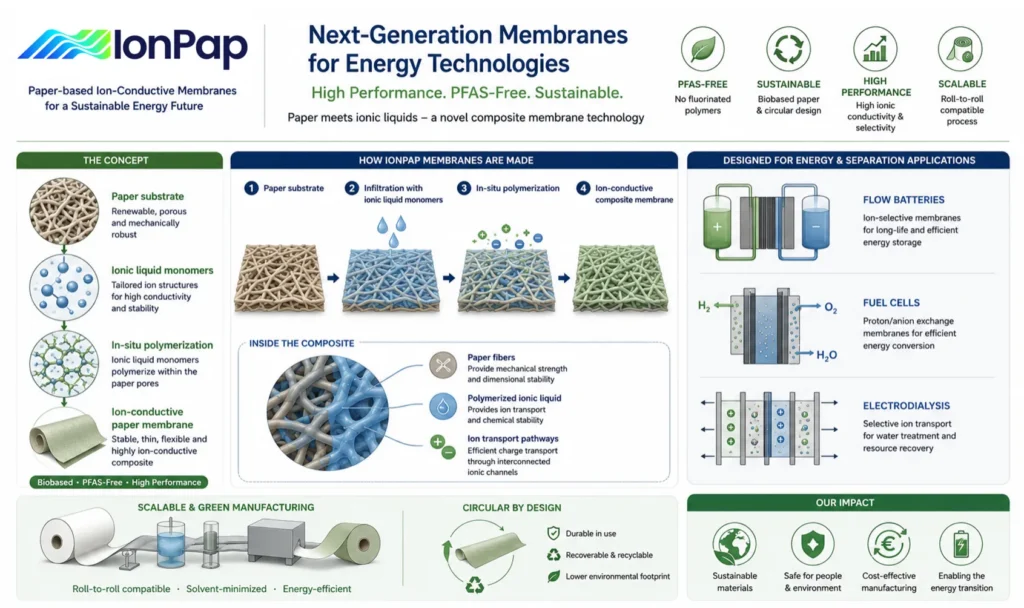
All of this is why the IonPap project casts this humble material as an unexpected hero for membrane technology and green energy. The technology utilizes the natural fibre network of paper to support a network of specialized poly(ionic liquids). These components create charged nanochannels for selective ion transport.
The benefits of a paper-based approach are not limited to its supporting fibre network. Paper is a renewable resource, highly available, non-toxic, recyclable, and biodegradable under the right conditions. Hence, this choice is aligned with the European Green Deal and the transition toward a circular economy. The unexpected hero faces synthetic unmasked villains, especially PFAS. Tables have turned.